How to decompress PDF streams online for free (unpack raw code and FlateDecode)

Quick summary
To decompress PDF streams online for free, you expand the internal compressed binary streams (such as FlateDecode, LZWDecode, and ASCII85Decode) into plain text PostScript and PDF syntax following the ISO 32000 standard. Using the AZ2PDF Decompress PDF tool, software developers, security analysts, and prepress technicians can unpack all page content operators in seconds with zero software installation, 100 percent free access, and complete in-memory privacy.
- Expose raw PDF code: Unpacking FlateDecode streams transforms unreadable binary blocks into clean, editable PostScript-like operators (BT, ET, Tf, Tj, cm, re, f) in plain text.
- Essential for developers and debugging: Quickly diagnose rendering anomalies, font encoding conflicts, incorrect bounding boxes, and malformed vector paths without compiling command-line utilities.
- Security and forensic auditing: Inspect embedded JavaScript dictionaries, hidden payload scripts, and structural anomalies obscured by standard Deflate compression filters.
- 100 percent free with instant in-memory processing: AZ2PDF unpacks all document streams directly in volatile server memory with zero fees, no account requirements, no watermarks, and automatic data purging within 5 minutes.
The hidden code inside PDFs: Why streams are compressed by default
To most computer users, a PDF file feels like a digital piece of paper or a static image. You double-click the file, and your viewer presents structured paragraphs, crisp logos, and neat tables. But underneath that visual layout lies an intricate, object-oriented programming language governed by the international ISO 32000 standard.
A standard PDF is constructed from discrete objects: dictionaries, arrays, numbers, strings, and streams. A stream is a sequence of bytes used to store large volumes of data, such as page rendering commands, vector drawing paths, font programs, and embedded metadata.
If every page content stream were saved in plain ASCII text, document sizes would quickly swell out of control. A simple twenty-page invoice report containing repetitive layout coordinates and typography calls could easily take up ten megabytes. To solve this problem, PDF generators (such as Adobe Acrobat, Ghostscript, Apache PDFBox, iText, and headless Chrome) compress internal streams using mathematical algorithms. While this makes files lightweight and fast to email, it also encrypts the internal syntax into an unreadable binary block.
To inspect, repair, or study what is written inside those objects, you need a way to unpack the data back into human-readable text without corrupting the document structure.
Inspect raw internal syntax and debug document corruption with the AZ2PDF Decompress PDF tool. It expands compressed FlateDecode data streams into readable plain-text PostScript operators and object dictionaries.
Inspect raw internal syntax and debug document corruption with the AZ2PDF Decompress PDF tool. It expands compressed FlateDecode data streams into readable plain-text PostScript operators and object dictionaries.
What is FlateDecode and why does raw PDF code look like gibberish?
When you open an ordinary PDF file in a code editor like Visual Studio Code, Sublime Text, or Notepad++, you might be able to read the initial header lines (such as %PDF-1.7) and basic dictionary keys like /Type /Catalog or /Pages. However, the moment your cursor reaches an actual content stream, the text turns into a chaotic wall of corrupted characters, random symbols, and question marks.
Here is what an object dictionary looks like right before the stream begins:
5 0 obj
<<
  /Length 1420
  /Filter /FlateDecode
>>
stream
xœí[msÛ8 … [unreadable binary garbage] …
endstream
endobj
The key responsible for this binary wall is /Filter /FlateDecode. In the PDF specification, FlateDecode designates the industry-standard zlib/deflate compression algorithm (defined in RFC 1950 and RFC 1951). Deflate scans the stream for repeated character sequences, replaces them with bit-level backward pointers, and applies Huffman coding to squeeze the data down to a fraction of its original size.
Because the stream bytes are packed at the bit level, text editors cannot interpret them as standard UTF-8 or ASCII characters. For everyday reading, this is fine because PDF viewers automatically decompress the stream in memory while rendering the page. But for programmers, forensic investigators, and document engineers, that binary wall prevents any inspection of the underlying commands.
To explore practical solutions for optimizing and manipulating document structures across your organization, visit AZ2PDF free online PDF tools for access to our complete collection of document utilities.
Key use cases: Who needs to decompress PDF internal streams?
Decompressing internal PDF streams is not a tool meant for casual file sharing, because expanding compressed streams makes file sizes larger. Instead, it is an indispensable diagnostic utility for technical specialists across several key disciplines:
- Software developers building PDF generation pipelines: If you write backend code using libraries like pdf-lib, ReportLab, FPDF, TCPDF, Puppeteer, or Apache PDFBox, unexpected rendering bugs are common. Text might overlap, fonts may render with wrong character spacing, or clipping boxes might cut off headers. By decompressing the output PDF, you can open the file in a text editor and inspect the exact drawing coordinates and matrix transformations (such as
cmandTmoperators) to pinpoint bugs in your code. - Prepress technicians and print shop operators: Commercial printing presses require rigorous color fidelity and font compliance. Prepress engineers decompress PDFs to verify whether embedded fonts have valid ToUnicode CMaps, inspect raw CMYK separation channels, and confirm that spot color separations are defined accurately before running costly industrial print jobs.
- Cybersecurity analysts and digital forensic researchers: Cybercriminals often hide malicious JavaScript payloads, command execution strings, or phishing redirection links inside compressed PDF streams. Standard antivirus scanners can sometimes miss sophisticated obfuscation techniques hidden behind multiple compression layers. Decompressing the entire object tree exposes hidden
/JavaScriptdictionaries, launch actions, and malformed xref entries directly to security inspection tools. - Students and document engineers learning PDF internals: Reading the official 1,000-page ISO 32000 specification can be overwhelming. Opening a decompressed, clean PDF file in VS Code lets you see exactly how pages, fonts, graphics states, and content trees interact in real life.
How PDF decompression works under the hood (ISO 32000 breakdown)
Decompressing a PDF is much more sophisticated than running an unzipping program like 7-Zip or WinRAR. A PDF file is not a generic archive; it is an interconnected graph of cross-referenced objects. Simply running an inflate routine on the file as a whole would destroy the file header, corrupt the xref table, and leave the document unreadable.
- Cross-reference mapping: The engine parses the PDF trailer and loads the cross-reference table (xref) to map every indirect object key (such as
1 0 R,2 0 R) in memory. - Stream detection and inspection: The parser iterates through the entire document tree. When it identifies an indirect object containing a stream dictionary, it inspects the dictionary keys for compression filters:
/Filter,/DecodeParms, and/D. Supported filters include FlateDecode (zlib), LZWDecode, ASCII85Decode, and RunLengthDecode. - Payload inflation: The compressed binary stream is decoded through an in-memory input stream back into raw uncompressed bytes.
- Filter dictionary stripping: The engine removes the
/Filterand/DecodeParmskeys from the object dictionary, signaling to any reader that the stream is now stored in raw uncompressed format. - Stream length recalculation: Because the stream has expanded from compressed binary into raw text, the original
/Lengthvalue is no longer valid. The engine recalculates the exact byte length of the decompressed content and updates the/Lengthinteger. - Uncompressed serialization: Finally, the document is re-serialized with explicit uncompressed parameters. The cross-reference table is completely rebuilt with updated byte offsets, guaranteeing that the output file opens smoothly in any standard PDF viewer without errors.
How to decompress PDF streams online in 3 simple steps
Unpacking raw PDF streams used to require installing command-line binaries, configuring compilation toolchains, or running manual Python scripts. With AZ2PDF, you can decompress any PDF document directly inside your web browser in seconds, completely free of charge:
Step 1: Upload your compressed PDF document
Navigate to the free Decompress PDF tool on AZ2PDF. Drag and drop your PDF file directly into the upload area, or click to browse files from your local storage. The tool works on Windows, macOS, Linux, iOS, and Android without requiring software installation or user accounts.
Step 2: Let the automated engine unpack internal streams
Once uploaded, the engine immediately begins traversing the document structure in volatile server memory. It detects all compressed content streams, decompresses the zlib payloads into readable syntax, strips compression filters, and recalculates object byte offsets.
Step 3: Download your uncompressed PDF file
When processing is complete, your decompressed document is ready for instant download (tagged with a convenient _decompressed.pdf suffix). Open the downloaded file in your favorite text editor (such as VS Code or Notepad++) to inspect, search, and edit the raw PDF operators freely.
If your decompressed object analysis reveals truncated byte offsets, you can quickly repair corrupt cross-reference tables if syntax errors persist to rebuild invalid cross-reference tables.
If your decompressed object analysis reveals truncated byte offsets, you can quickly repair corrupt cross-reference tables if syntax errors persist to rebuild invalid cross-reference tables.
Inspecting raw PDF syntax: What you will see inside a text editor
Once you open your decompressed PDF in a text editor, the mysterious binary blocks disappear completely. In their place, you will see clean PostScript-style graphic operators that define how every word and vector shape appears on the page.
Here is an example of what an uncompressed page content stream looks like:
5 0 obj
<<
  /Length 284
>>
stream
q
1 0 0 1 50 720 cm
BT
/F1 16 Tf
18 TL
(Welcome to Document Engineering) Tj
T*
/F2 11 Tf
(All page content streams are now fully human-readable.) Tj
ET
0.2 0.4 0.8 rg
50 680 500 2 re
f
Q
endstream
endobj
Understanding these basic operators makes inspecting your documents straightforward:
qandQ: Save and restore the graphics state stack (preserving line widths, colors, and transformation matrices).cm: Current Transformation Matrix, setting the exact position, scaling, or rotation of page elements.BTandET: Begin Text and End Text blocks. Any text rendering must happen between these two operators./F1 16 Tf: Sets the current font resource to font F1 at a font size of 16 points.Tj: Shows a text string on the page. You can directly read the words inside the parentheses.T*: Moves the text cursor down to the start of the next line according to the leading parameter (TL).reandf: Defines a rectangle coordinate (x, y, width, height) and fills it with the current color.
With decompressed streams, finding a missing line of text or tracking down why an image is positioned at negative coordinates takes just a simple Ctrl+F search in your text editor.
Online browser tool versus command-line utilities (qpdf and mutool)
In traditional developer environments, programmers typically turn to command-line utilities to unpack PDF streams. The two most prominent terminal tools are qpdf and MuPDF mutool:
- qpdf command syntax:
qpdf --qdf --object-streams=disable input.pdf output.pdf - mutool command syntax:
mutool clean -d input.pdf output.pdf
While these CLI tools are powerful, they present significant friction in everyday work:
- They require installing third-party package managers (such as Homebrew on macOS or apt on Ubuntu) and compiling C++ dependencies.
- They cannot be run on locked corporate laptops, mobile devices, tablets, or Chromebooks where terminal access is restricted.
- Junior developers, designers, prepress operators, and legal investigators may not be comfortable navigating command-line arguments and file paths.
The AZ2PDF online decompressor gives you the exact same professional-grade stream unpacking capability through a clean browser interface. You get instant results without installing software, updating terminal paths, or typing command-line flags.
Important side effects: Why decompressed files are larger and when to re-compress
When working with decompressed PDF documents, it is important to be mindful of two practical technical considerations:
1. File size increases substantially
Because FlateDecode compression typically achieves a 60% to 85% compression ratio on vector graphics and text commands, unpacking these streams will increase the total file size. A 500 KB compressed report might expand to 2 MB or 4 MB once all object streams are decompressed. For this reason, decompressed PDFs should be used for testing, inspection, and development environments rather than final customer distribution.
2. How image streams behave
PDF documents store embedded photographs using dedicated image filters, such as /DCTDecode for JPEG images and /JPXDecode for JPEG 2000 images. Decompressing a PDF unpacks FlateDecode page streams, metadata, and font dictionaries into plain text, but it does not convert binary JPEG photo streams into text characters. Photos remain valid bitmap images so the document renders correctly in standard viewers.
3. Re-compressing your file before distribution
Privacy first: In-memory stream processing with zero server retention
PDF documents submitted for debugging and technical inspection often contain proprietary source code, confidential business statements, or sensitive draft contracts. When using an online tool, data confidentiality is paramount.
Many legacy web converters write user documents to permanent server hard drives, retain files for days, or log document contents into commercial tracking databases. Some even monetize user files by harvesting training data for external artificial intelligence models.
At AZ2PDF, we maintain an uncompromising privacy standard:
- Ephemeral in-memory processing: Document parsing, stream decompression, and xref reconstruction occur strictly inside temporary volatile RAM buffers. No files are written to permanent storage drives.
- Automated 5-minute purge daemon: A dedicated background cleanup daemon runs continuously across our infrastructure. Every temporary buffer is permanently and irreversibly destroyed within 5 minutes of processing.
- 100 percent free with no account registration: You never need to supply an email address, enter credit card details, or create an account. You remain completely anonymous from start to finish.
- Zero advertising watermarks: Your decompressed PDF remains 100 percent clean. We never insert promotional logos, trial banners, or branding stamps onto your pages.
Perform in-depth document engineering analysis with the AZ2PDF deep document inspection platform, giving developers total transparency without exposing source files to external networks.
Perform in-depth document engineering analysis with the AZ2PDF deep document inspection platform, giving developers total transparency without exposing source files to external networks.
❓ Frequently asked questions
Because standard PDF documents compress their page content streams, font descriptors, and metadata dictionaries using zlib Deflate compression (represented by the /Filter /FlateDecode dictionary key). The text editor tries to display compressed binary data as ASCII text, resulting in unreadable characters. Decompressing the PDF removes these filters and expands the binary streams into readable text operators.
Related articles in this topic
Deep dive into related document organization and page manipulation workflows.
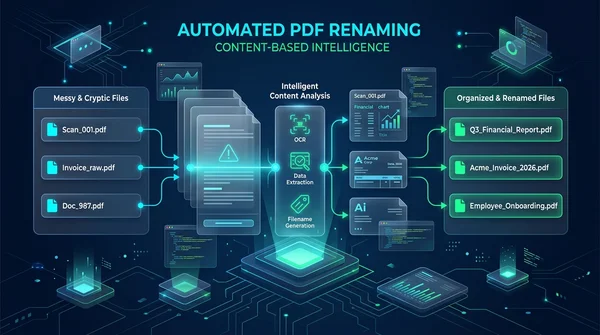
How to auto rename PDF files online for free (based on content)
Learn how to auto rename PDF files online for free based on document content and title tags. Organize cryptic scanner files and invoices with zero quality loss.

How to repair corrupted PDF files online (free and secure)
Learn how to fix damaged or unreadable PDF files online for free. Rebuild broken xref tables, recover truncated content streams, and restore document access securely.
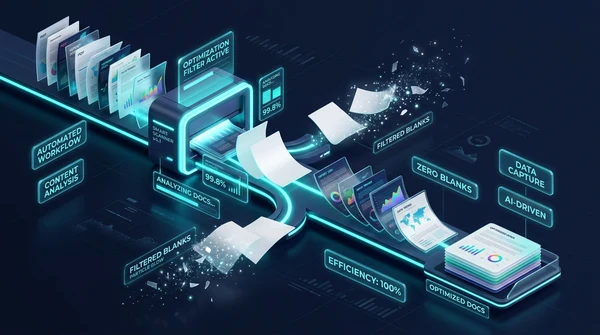
How to detect and remove blank pages from scanned PDFs online
Learn how to automatically detect and remove blank pages from scanned PDFs online for free. Eliminate empty duplex scan pages without quality loss or manual editing.

How to convert PDF to ISO-standard PDF/A for long-term archiving
Learn how to convert PDF documents to ISO 19005-compliant PDF/A format online for free. Embed fonts, standardize color spaces, and ensure permanent preservation.
How to password protect a PDF for free (AES-256 encryption)
Learn how to password protect and encrypt PDF files online for free using military-grade AES-256 encryption. Keep confidential contracts, bank statements, and payroll files private with zero watermarks.
How to unlock a password protected PDF online (remove security permanently)
Learn how to remove passwords and permission restrictions from authorized PDF files online for free. Decrypt your documents securely with zero watermarks.